
Mythic Star System Creator
Mythic Compilation 8 or Volume 46

I’m a huge fan of sci-fi. Mothership is probably my favorite game to solo roleplay. Coming in a very close second is Ironsworn: Starforged. In fact, when I am playing Mothership, and I need to generate oracle table rolls, I often use Starsmith Expanded Starforged Oracles by Eric Bright.
In the spirit of my recent love of going through the Mythic Magazines and running the “Crafter/Creator” processes (see previous articles for Fantasy World Crafter and City Crafter), I found the Star System Creator in Mythic Magazine Volume 46 within the Mythic Compilation 8. I would normally tie this into a current campaign I am running, but I have already created a system for my current Gradient Descent campaign.
I thought it might be fun to create another one from scratch using Tana’s procedure, and perhaps I can use it later in my campaign! In addition to the star system creator, it also contains mechanisms for why your character is exploring this star system, which makes for a great adventure hook!
Who knows, maybe I’ll do a quick one-shot with a character and he/she will end up meeting with my Gradient Descent party at some point! Without further delay, let’s get rolling!
Why are we here?
No, that isn’t an existential crisis question. Why is my character in this place? I rolled on the Star System Exploration Focus table and got: LOST IN SPACE. Somehow, you’re lost. Really lost. Hopefully something here can help you. Roll on the Action Meaning tables for inspiration about how you became lost.
Action Meaning Table rolls: Assist + Safety
My character was pulled out of their hyperspace jump by some sort of distress gravity interdiction beacon. It is normally reserved for very expensive vessels that can pull nearby travelers out of hyper so they must provide assistance. It can also be used as a trap by pirates…but a really expensive trap.
For giggles (not a part of this process), what kind of character will I be?
Character Identity tables: Enforcer. So I work as some sort of security force. That’s enough for now, that’s not the focus of this article. ;)
Star System Characteristics
The star system will have certain aspects that we will roll up from the provided tables. It will consist of the star’s name, number of explorable planets, and other distinguishing features.
Naming the Star
The process for naming the star contains 3 tables. Star Name Focus, Star Name First Half, and Star Name Second Half.
First I’ll roll on the Star Name Focus: Designation - Roll on the Star Name First Half table twice, but only use the first letter of each rolled result. Add a number by rolling d100 twice.
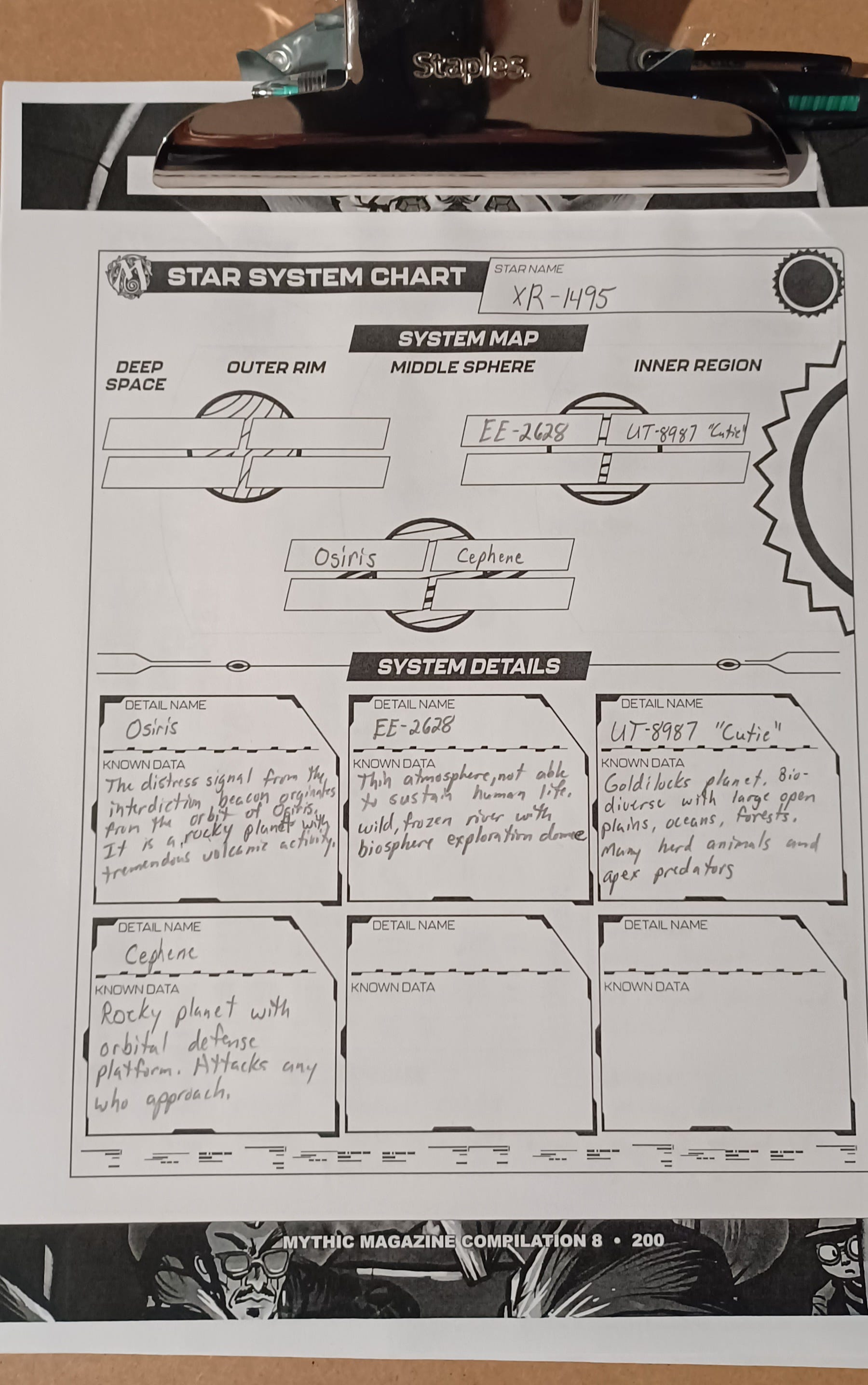
My Star Name: XR-1495
Star System Layers
There are 4 layers to our star system layout. Deep Space, Outer Rim, Middle Sphere, and Inner Region. We will roll 1d4+2 features and then roll to see in which layer they will belong.
Tana mentions that these are not the ONLY features to be found in this system. Rather, the most interesting that your character would focus on first. If you need additional features later, it gives you that narrative flexibility to do so. I really like that.
The 6 features will be constrained to no more than 4 in any given layer. If you roll more than that for a single layer, shift it to an adjacent one. Note: Deep space is outside of the sphere of gravitational influence for the given star, so generally has no features.
Features in our system 1d4+2:4
First Feature
I’ll roll on the Star System Layer table to determine where my first feature will be.
d10=4 Middle Sphere. The Middle Sphere is the vast region between the Outer Rim and the Inner Region. This is usally an active place, with planets and asteroid belts and possible anomalies. Planets are common in this layer. You are likely to find gas giants and planets that have more moons than those in the other layers. The Middle Sphere is only marginally more likely to hold life than the Outer Rim.
Next, we’ll roll on the Middle layer section of the Star System Feature Focus table. I like that the odds are stacked in this table depending on which layer it is located.
d100 Middle=48 Solid Planet of Interest. It’s a planet, apparently devoid of life, but it has a complex and interesting geological system. These are planets that aren’t cold or hot dead worlds, or worlds with abundant life, but they offer their own natural richness. The planet is solid and can be landed on and explored.
Planet Name Focus: 32 Planet Name. Roll on the first and second halves of the Planet Name tables and combine them.
Ros + esis. I’m going to flip it around a bit and derive: Osiris.
For some detail, I’ll roll on the Terrain Descriptor tables: River + Communicate
Fate check, is the river made of lava? 47 vs 50 Yes.
Fate check, does it have an atmosphere? 99 Extreme No. If it had simply been a no, I might have made it a toxic atmosphere.
The distress signal from the interdiction beacon originates from the orbit of the planet, Osiris. It is a rocky planet with tremendous volcanic activity. Rivers of lava run so large, they can be spotted from space. With no atmosphere to cool them, they take centuries to return to solid stone.
Second Feature
Star System Layer roll d10: 7 Inner Region. This is the warmest, most energy rich part of the system, closest to the star. This layer usually has planets and other features. Planets within this region are the most likely to hold life.
d100 Inner=75 Interesting Moon. A moon orbiting a planet draws your attention for some reason. Perhaps the planet is interesting too, but as I mentioned previously, this process allows for further detail to emerge during gameplay.
Planet Name Focus: Designation. EE-2628
For detail, I’ll roll once on the Locations table and twice on the Terrain tables: Official + River + Wild
Fate check, does this moon have an atmosphere, very likely (due to official)? 75 vs 75 Yes. Since it was so close though, I will say the atmosphere is not fit for human life.
Fate check, is there life on this moon? 85 vs 50 No.
I’ll roll on the the Civilization Descriptor to get an idea of what is “official” about this place: Lawful.
The moon designated EE-2628 has a thin atmosphere, not enough to sustain human life. Beside a wild frozen river that crosses one of the large plateaus, a domed biosphere settlement provides shelter for an exploration expedition on this moon. Perhaps whomever sent out the distress beacon ended up here? Did something happen in the past to remove the atmosphere and cause the once running water to freeze over? Strangely, my character recognizes the transponder code emanating from the settlement as belonging to the same security corporation he works for.
Third Feature
Star System Layer roll d10: 8 Inner Region
d100 Inner: 18 Living Earth-like planet. A planet with plants, animals, oceans, and a breathable atmosphere. It is about as close to being Earth without being on Earth. Still, its another world, and will have its own unique features.
I’m going to assume the previous moon belongs to this planet, and perhaps is acting as a low-gravity forward base of operations for the exploration of the planet.
Planet Name Focus: 93 Designation. UT-8987. I like to think the people assigned to exploring the place simply call it “Cutie.”
Since it is established it has life, I would roll on the Creatures table when/if my character visited to establish what lives there. For now, I’ll roll Civilization + Location + Forest + Terrain. There would be multiple biomes we could define for a great planet like this.
Healthy + Open + Adversity + Threatening
Fate check, is any of the life sentient? 89 vs 50 No.
The goldilocks planet, UT-8987 colloquially called “Cutie” is anything but cute. The bio-diverse planet ranges from large open plains, vast oceans, and dense forests. Something common to all of the biomes is the abundance of herd animals. And with all of that food, highly effective apex predators.
Fourth Feature
Star System Layer roll d10: 4 Middle Sphere
d100 Middle=53 Solid Planet of Interest.
Planet Name Focus: 56 Planet Name. Ceph + ene. Cephene
I’ll roll twice on the Terrain Descriptor tables: Scary + Defense
Orbiting the rocky planet Cephene, a large silent orbital defense platform bristles with weaponry. Any attempts to approach the station to investigate further are fired upon. Who built this station? Are they still there or is it automated?
Star System Events
Now that the system has been created and we have established a hook as to how we ended up here, you can roll on the Star System Events table to determine what happens next. I think if I was playing this, I would have enough to work with already to start my adventure. Here is what I would surmise:
A luxury safari ship was enroute to Cutie (UT-8987) for wealthy patrons to go on an exotic hunt. The ship flew too near the Cephene defense station and was damaged or destroyed. It is up to us to follow the beacon and derive what happened to the ship and its passengers. Perhaps our fellows at the exploration post on the moon EE-2628 might know more.
For the sake of finishing the process though, I will roll on the focus table and see what other event might arise, possibly as an Interrupt Scene while I was pursuing the above.
Star System Event Focus d100=39 Objects in Space. Your ship detects something floating in space outside the ship. You had not previously detected it until getting closer. Roll on the Objects table for inspiration. Perhaps this is debris from the luxury liner?
As you travel in the system, Tana recommends you roll a Fate check to see if an event occurs based on the context of your adventures, using the chaos factor and probabilities.
Conclusion
I found the process extremely enjoyable. While it differs significantly from how Starforged generates systems and planets, this is a solid alternative, and I’m eager to find out what happened to those rich louts?!
Love this! I want to play more Sci-fi this year, but I'm not as good at improv with sci fi themes in comparison to fantasy or modern. This looks like such a great way to build something that feels tangible from the ground up!
Love how procedural generation meets narrative design here. The layered approach to system creation (Deep Space to Inner Region) feels more intuitive than pure random tables because it maps to actual orbital mechanics. Back when I ran Traveller campaigns, building systems from scratch always felt like too much spreadsheet work, but this strikes a nice balance between structure and emergence. The interdiction beacon hook is particulary clever for tying exploration to player agency.